


- HOME
- TREATMENTS
- SkinRx Personalised Skin Treatments | Sculpture Clinic

SkinRx Personalised Skin Treatments | Sculpture Clinic
SkinRx – Your Personalised Skin Treatment Journey
Your skin is individual. Your treatment should be too.
Healthy-looking skin begins with understanding what your skin needs, not simply choosing another product or procedure.
At Sculpture Clinic in Gravesend, Kent, we believe that effective skin management should be guided by clinical assessment, evidence-based treatment and ongoing care.
That is why we developed SkinRx, our personalised dermatology and skin management programme.
SkinRx brings together clinical consultations, VISIA skin analysis, prescription treatments where appropriate, personalised NeoDerm formulations and professional skin procedures.
Whether you are concerned about acne, rosacea, pigmentation, enlarged pores, skin ageing or sensitivity, our approach follows five carefully considered stages.
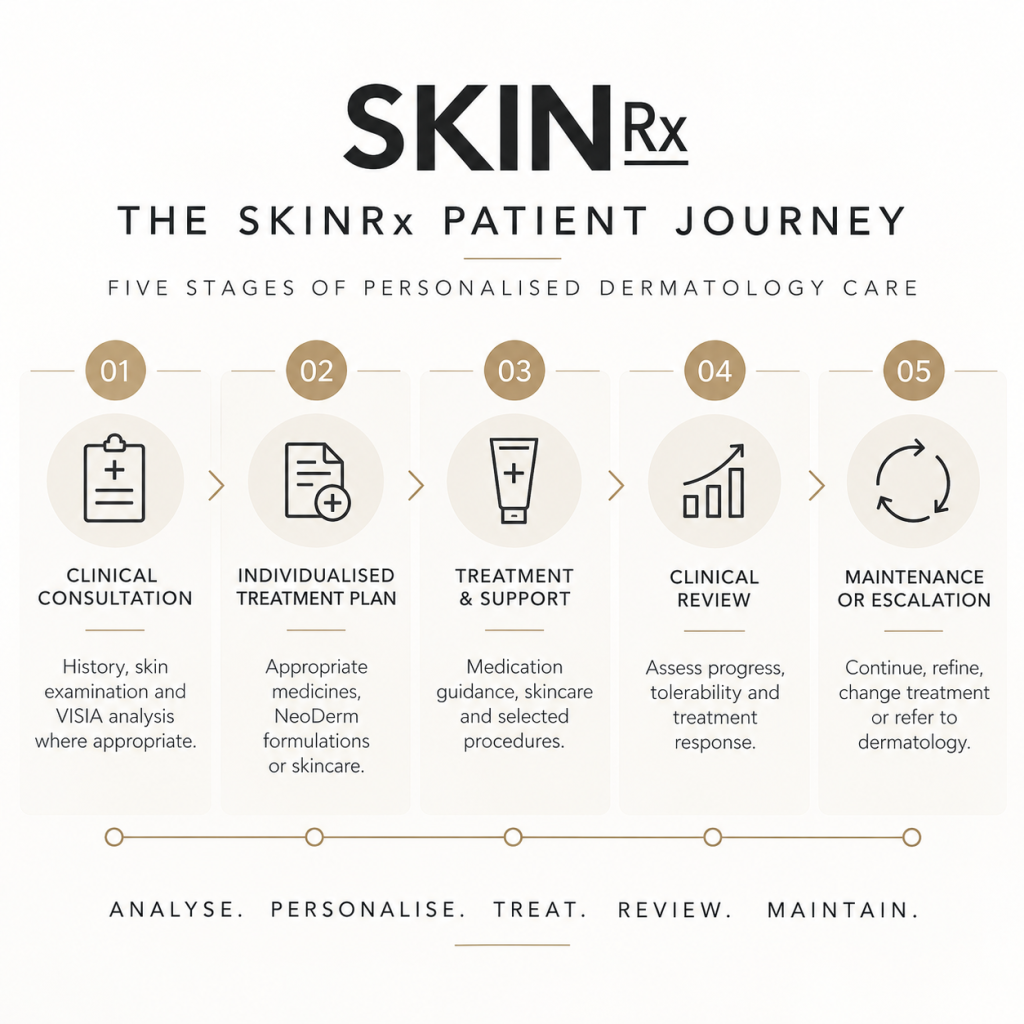
Analyse. Personalise. Treat. Review. Maintain.

The Five Stages of Your SkinRx Journey
Stage 1 – SkinRx Clinical Consultation
Understanding your skin before recommending treatment.
Every SkinRx journey begins with a clinical consultation.
Rather than selecting treatments based on appearance alone, we take time to understand your skin concerns, medical history, current skincare routine and previous treatment experiences.
Your consultation may include:
- A discussion of your main skin concerns and treatment goals.
- Review of relevant medical conditions, medicines and allergies.
- Assessment of previous skincare products and professional treatments.
- Clinical examination of the skin.
- VISIA skin imaging where appropriate.
- Consideration of whether further investigation or dermatology referral is required.
How VISIA Skin Analysis Helps
VISIA imaging provides an additional way to examine and document visible skin characteristics.
Depending on the analysis performed, it can assess features including pigmentation, pores, wrinkles, skin texture, redness and UV-related imaging patterns.
These findings can help support treatment planning and provide a reference for future comparisons.
VISIA does not replace clinical diagnosis. Its findings are interpreted alongside your medical history and skin examination.
The SkinRx difference: We begin by understanding your skin rather than recommending a procedure before establishing what is causing the concern.
Stage 2 – Your Individualised Treatment Plan
Selecting the right treatment for your skin, not simply the most intensive one.
Once we have assessed your skin, we develop a personalised management plan.
This may involve a simple home skincare routine, an established dermatological medicine, a specialist formulation or a professional procedure.
The choice depends on your diagnosis, skin characteristics, treatment history, preferences and clinical suitability.
Evidence-Based Dermatology Treatments
Where medication is indicated, we consider established licensed treatments appropriate to the condition.
These may include treatments for acne, rosacea, pigmentation or inflammatory skin disorders.
Prescription medicines are supplied only following appropriate clinical assessment and prescribing.
NeoDerm Personalised Formulations
For selected patients whose individual clinical needs cannot be adequately met by a suitable licensed medicine, a specially prepared NeoDerm formulation may be considered.
NeoDerm is our proposed range of targeted dermatology formulations, using selected active ingredients according to the patient’s clinical requirements.
These may focus on concerns such as pigmentation, acne, visible pores, skin ageing or barrier support.
Unlicensed compounded medicines are not automatically preferable to licensed products. Their use requires a documented clinical justification and appropriate prescribing safeguards.
Personalised Medical-Grade Skincare
Not every skin concern requires a prescription.
Some patients may benefit from carefully selected skincare ingredients, including niacinamide, suitable vitamin A derivatives, exfoliating acids, moisturisers and sun protection.
The aim is to build an effective routine without unnecessary products or excessive irritation.
The SkinRx difference: Your treatment plan is based on clinical need, with the simplest suitable approach considered before more intensive options.
Stage 3 – Treatment and Ongoing Support
A treatment plan works best when you understand how to follow it.
Once your SkinRx plan has been agreed, we guide you through the recommended treatments.
This includes clear instructions on how to use prescribed or recommended products, how to introduce active ingredients and what changes to expect.
Medication and Skincare Guidance
Where appropriate, we explain:
- How and when to apply your treatment.
- How much product to use.
- Which products should not be combined.
- How to recognise irritation or adverse effects.
- When improvements may become noticeable.
- When to stop treatment and seek advice.
- How to maintain effective daily sun protection.
Professional Treatments Within SkinRx
Some patients may benefit from professional procedures alongside their home skincare.
Depending on clinical suitability, these may include:
HydraFacial
For cleansing, exfoliation, hydration and management of superficial congestion.
Microneedling
For selected acne scars, uneven texture and collagen-related skin concerns.
NeoGen Nitrogen Plasma
For selected patients with photoageing, fine lines, wrinkles and textural changes.
Chemical Peels
For controlled exfoliation and management of selected acne-related or pigmentation concerns.
Tri-Wave LED
As an adjunctive treatment where an appropriate indication and protocol have been established.
Not every patient requires professional treatment. For many conditions, appropriate topical therapy and consistent skincare may be sufficient.
NeoPrep: Preparing Skin for Professional Procedures
Where suitable, your SkinRx programme may incorporate NeoPrep, our personalised skin preparation pathway.
This can include assessing pigmentation risk, supporting hydration, reviewing active ingredients and planning recovery before procedures such as NeoGen or microneedling.
The preparation is individualised, particularly for patients with sensitive skin or a history of post-inflammatory hyperpigmentation.
The SkinRx difference: We provide guidance throughout treatment rather than leaving you to manage a complex skincare routine independently.
Stage 4 – Clinical Review and Progress Assessment
Effective skin management involves monitoring, not guesswork.
Your skin’s response to treatment is an important part of the SkinRx process.
Some concerns improve within weeks, while others, including pigmentation, acne and photoageing, may require several months of treatment.
At your review appointment, we assess how your skin is responding and whether your current programme remains appropriate.
This may include:
- Reviewing improvements in your original skin concerns.
- Assessing irritation, sensitivity or adverse effects.
- Discussing how consistently treatment has been used.
- Reviewing any difficulties with the skincare routine.
- Repeat clinical examination.
- VISIA imaging and standardised photographs where appropriate.
- Considering whether treatment needs adjustment.
Why Repeat VISIA Imaging?
Repeat imaging may help document changes in visible skin characteristics over time.
However, imaging results are interpreted carefully because lighting, positioning and skin condition can affect comparisons.
We consider the overall clinical response rather than relying solely on numerical imaging scores.
The SkinRx difference: Treatment decisions are reviewed according to your response, rather than continuing the same programme indefinitely without reassessment.
Stage 5 – Maintenance, Refinement or Specialist Escalation
Good skin management is about knowing when to continue, change or stop.
The final stage of SkinRx focuses on maintaining improvements and responding appropriately when treatment goals have not been achieved.
Your ongoing plan may involve several possible approaches.
Maintain
If your skin is responding well, we may recommend continuing a suitable maintenance routine.
This could involve simplified skincare, ongoing sun protection or periodic professional review.
Refine
If a treatment is providing partial benefit, we may adjust the formulation, application frequency or wider skincare programme.
The aim is to improve effectiveness without unnecessarily increasing treatment intensity.
Change
If a treatment is ineffective or poorly tolerated, an alternative approach may be more appropriate.
This may involve a different topical medicine, skincare formulation or treatment strategy.
Refer
Some skin conditions require specialist assessment or treatment beyond the scope of the clinic.
Where appropriate, we can recommend dermatology referral for further investigation or management.
Referral may be necessary at the initial consultation rather than after a trial of treatment, particularly where a suspicious lesion, severe disease or diagnostic uncertainty is identified.
The SkinRx difference: Our objective is to recommend what your skin needs, including recognising when specialist care is the most appropriate option.
What Skin Concerns Can SkinRx Help Manage?
SkinRx can be adapted to a range of dermatological and cosmetic skin concerns.
Acne and Adult Blemishes
From comedonal acne to inflammatory breakouts, SkinRx considers appropriate topical treatments, skincare tolerance and the risk of acne scarring.
Rosacea and Facial Redness
Rosacea may involve persistent redness, inflammatory papules, pustules and skin sensitivity.
Treatment depends on the presentation, with medical therapy and gentle skincare often forming the foundation of care.
Pigmentation and Melasma
SkinRx considers the cause of pigmentation before recommending topical treatments or procedures.
Photoprotection and careful management of inflammation are particularly important.
Enlarged Pores and Oily Skin
Visible pores may be influenced by oil production, congestion, genetics and changes in skin elasticity.
Management may include selected skincare ingredients and professional treatments where appropriate.
Skin Ageing and Uneven Texture
For concerns involving fine lines, photoageing and uneven skin texture, SkinRx may incorporate retinoids, sun protection and selected collagen-focused procedures.
Sensitive Skin and Barrier Dysfunction
Where the skin is dry, irritated or reactive, the priority may be to simplify the routine, identify triggers and support barrier function.
Why Choose SkinRx at Sculpture Clinic?
SkinRx brings together the clinical and practical elements of personalised skin management.
Clinical expertise
Assessment informed by dermatology and prescribing knowledge.
VISIA skin imaging
Advanced imaging to support clinical assessment and help document changes.
Individualised skincare
Selection of ingredients according to your skin concerns, treatment goals and tolerability.
NeoDerm formulations
Targeted compounded preparations where an individual clinical need justifies their use.
Professional treatment options
Access to HydraFacial, microneedling, NeoGen and other suitable procedures.
Continuity of care
Structured reviews and the ability to refine your treatment programme as your skin changes.
Above all, SkinRx is designed to help you understand your skin and make informed decisions about its care.
Frequently Asked Questions
Is SkinRx suitable for everyone?
SkinRx is a personalised assessment and treatment planning service. The suitability of individual medicines, formulations and procedures depends on clinical findings and medical history.
Do I need VISIA imaging?
Not necessarily. VISIA can provide useful supplementary information, but clinical examination remains central to diagnosis and treatment planning.
Will I receive a prescription at my consultation?
Only if a prescription medicine is clinically indicated and appropriate. Some patients may benefit from non-prescription skincare or professional treatments instead.
Are NeoDerm formulations available to everyone?
No. Compounded prescription formulations are considered only where clinically justified and subject to appropriate prescribing and supply arrangements.
How many appointments will I need?
This depends on your skin concern and treatment plan. Some patients may require only an initial consultation and review, while others benefit from longer-term monitoring.
Can I continue my existing skincare?
Often, yes. We review your current products and aim to retain suitable products rather than replace your entire routine unnecessarily.
What if my skin does not improve?
Your treatment will be reviewed. We may adjust the plan, consider alternative treatment or recommend specialist dermatology assessment where appropriate.
Begin Your SkinRx Journey
Better skin management begins with understanding your skin.
At Sculpture Clinic in Gravesend, Kent, SkinRx offers a personalised approach to dermatology and skincare, bringing together clinical assessment, VISIA imaging, targeted treatment and ongoing review.
Whether you are concerned about acne, rosacea, pigmentation, visible pores, sensitivity or signs of ageing, we can help you explore the most appropriate options.
SkinRx – Analyse. Personalise. Treat. Review. Maintain.
Sculpture Clinic
Gravesend, Kent
Clinical References
National Institute for Health and Care Excellence (NICE) (2021, updated 2023) Acne vulgaris: management (NG198). Available at: https://www.nice.org.uk/guidance/ng198
National Institute for Health and Care Excellence (NICE) (2024) Rosacea – acne: Clinical Knowledge Summary. Available at: https://cks.nice.org.uk/topics/rosacea-acne/
Medicines and Healthcare products Regulatory Agency (MHRA) (2014, updated subsequently) The supply of unlicensed medicinal products (specials). Available at: https://www.gov.uk/government/publications/supply-unlicensed-medicinal-products-specials
General Pharmaceutical Council (GPhC) (2017) Standards for pharmacy professionals. Available at: https://www.pharmacyregulation.org/
British Association of Dermatologists (2021) ‘British Association of Dermatologists guidelines for the management of people with rosacea 2021’, British Journal of Dermatology, 185(4), pp. 725–735.


