


- HOME
- Expert Guides
- VISIA Before & After Skin Analysis | Gravesend
VISIA Before & After Skin Analysis | Gravesend
Tracking Your Skin Transformation: Why Repeat VISIA Imaging Matters
How do you know whether your skincare and treatments are actually making a difference?
When looking at your face every day, gradual changes can be difficult to recognise.
You may notice that your skin feels smoother, looks brighter or appears more even, but remembering exactly how it looked several months earlier is not always easy.
At Sculpture Clinic in Gravesend, we use repeat VISIA Skin Analysis to help document selected skin characteristics throughout your treatment journey.
Our aim is not simply to take before-and-after photographs. It is to use the information to review progress and make informed decisions about what happens next.

Why an initial VISIA assessment matters
Before starting a personalised skin programme, we aim to establish a baseline.
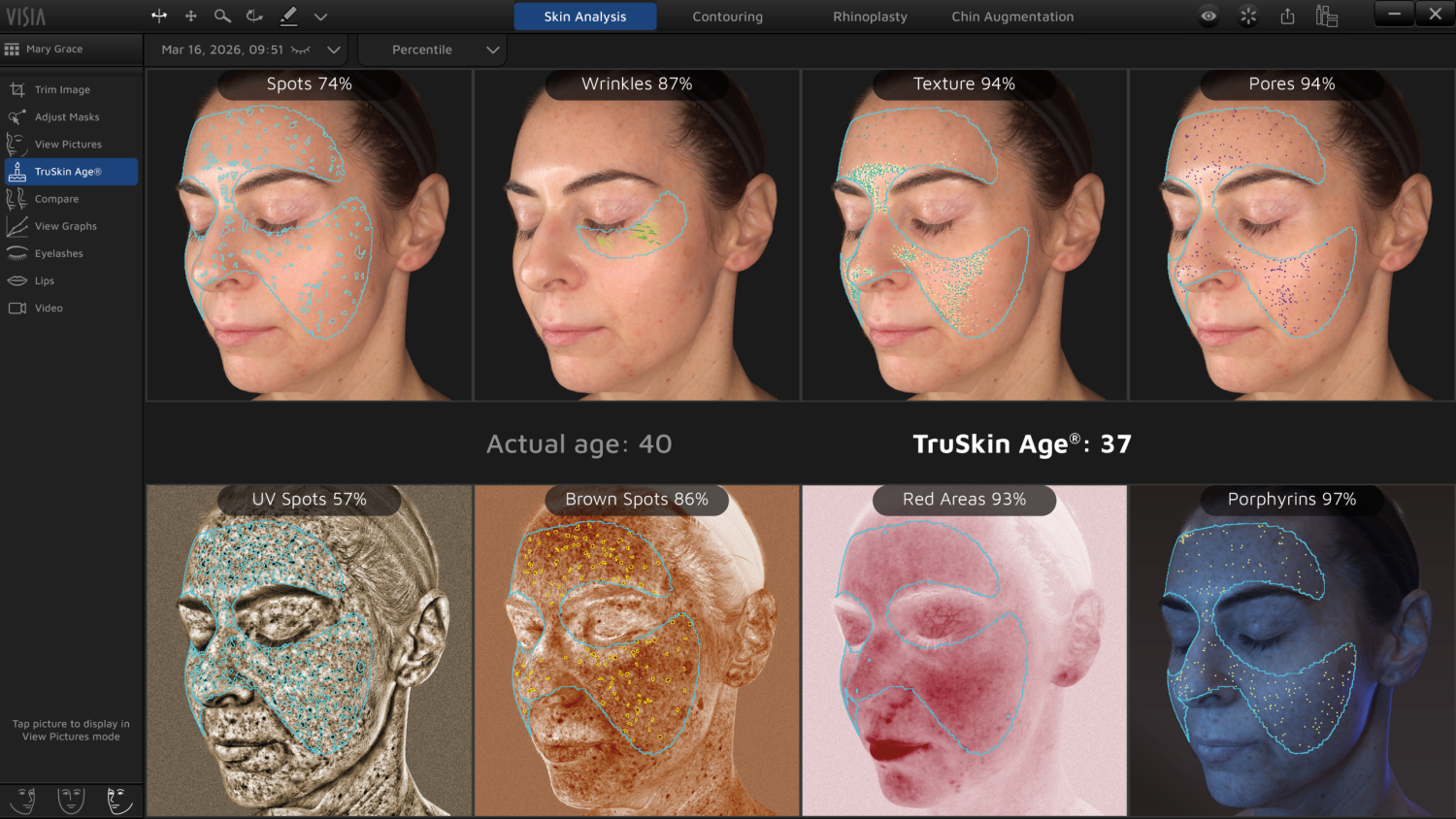
VISIA captures standardised facial images and provides analysis of several features, including wrinkles, texture, pores, pigmentation and redness.
These images help us document your starting point.
We combine this information with a clinical consultation to understand your concerns, treatment history and expectations.
This allows us to establish realistic goals and agree how progress will be reviewed.
What happens when we repeat the imaging?
At subsequent appointments, VISIA can capture new images for comparison with your original assessment.
Where imaging conditions are consistent, we can examine whether selected characteristics appear to have changed.
For example, we may compare:
- The appearance of fine lines and wrinkles.
- Changes in visible skin texture.
- The distribution of brown pigmentation.
- The appearance of pores.
- Areas of visible redness.
- UV-associated pigmentation patterns.
These comparisons can support a more structured conversation about treatment progress.
However, VISIA scores and photographs are not definitive measures of treatment success. Differences in skin preparation, recent procedures, inflammation and imaging conditions may affect the results.
How often should VISIA imaging be repeated?
There is no single interval that is appropriate for every treatment.
The timing depends on what we are treating, the intervention used and how quickly meaningful changes might be expected.
For example, patients using targeted skincare for pigmentation may benefit from review after several weeks, whereas skin-remodelling treatments may require longer before their effects can be assessed.
At Sculpture Clinic, review appointments may be considered at approximately four, eight or twelve weeks, or at other clinically appropriate intervals.
These are individual review points rather than a fixed imaging schedule.
The purpose is to gather useful information, not simply repeat photographs unnecessarily.
How imaging helps us refine your skincare
Imagine a patient who begins a personalised skincare routine to address uneven pigmentation.
At their review, they report that their skin feels comfortable and that they have followed the routine consistently.
Repeat VISIA imaging may show an improvement in some visible pigmentation characteristics, while other areas remain relatively unchanged.
We can then review whether the existing approach should continue or whether adjustments are appropriate.
Alternatively, if the patient develops irritation, the priority may be to simplify the routine even if some imaging measurements appear improved.
This is why we consider both the images and the patient’s experience.
Monitoring HydraFacial treatment
HydraFacial may produce noticeable short-term improvements in the appearance and feel of the skin.
However, repeat imaging is more useful when it is performed at meaningful intervals rather than immediately after treatment.
This helps us distinguish temporary cosmetic effects from changes that may be maintained over time.
Monitoring NeoGen and microneedling
Following NeoGen or microneedling, skin recovery and remodelling can occur over an extended period.
Imaging too early may capture temporary redness, dryness or post-treatment changes rather than the eventual result.
We therefore consider the stage of recovery when arranging follow-up assessments.
VISIA can document visible changes in texture and wrinkles, but it cannot directly confirm collagen remodelling or quantify changes in dermal collagen.
Reviewing SkinRx and Tri-Wave
For patients following a SkinRx programme, repeat imaging provides another opportunity to evaluate the overall approach.
We can review skincare tolerance, consistency, treatment response and whether the original priorities remain relevant.
Where Tri-Wave LED therapy has been incorporated, imaging may help document the overall programme’s progress.
However, when several treatments are used together, VISIA cannot establish which individual treatment caused an observed change.
Why consistency is important
To make comparisons more meaningful, imaging should be performed using a consistent approach.
This includes appropriate positioning, similar skin preparation and standardised imaging conditions.
Recent procedures, make-up and other temporary influences should also be considered when interpreting results.
Even with standardised photography, changes in VISIA measurements should be interpreted alongside clinical findings.
Your skin transformation is a journey
At Sculpture Clinic, we believe that treatment should be reviewed rather than repeated automatically.
If your skin is responding well, we may continue the existing plan.
If progress is limited, we can reconsider the treatment strategy.
If your skin has achieved the desired improvement, we can discuss an appropriate maintenance programme.
The goal is not to chase perfect imaging scores. It is to help you achieve healthier-looking skin through a thoughtful, personalised approach.
Book your VISIA Skin Analysis at Sculpture Clinic in Gravesend and discover how ongoing skin assessment can support your treatment journey.
References
Canfield Scientific (n.d.) VISIA Complexion Analysis. Available at: https://www.canfieldresearch.com/imaging-systems/visia-complexion-analysis/
Canfield Scientific (2024) VISIA Featured in Allure Magazine. Available at: https://www.canfieldresearch.com/in-the-news/stories/visia-featured-in-allure-magazine-/
Canfield Scientific (n.d.) VISIA-CR. Available at: https://iveos.canfieldsci.com/imaging-systems/visia-cr/


